Fieldstone Wordpress Plugin - Rating, Reviews, Demo & Download

Plugin Description
Fieldstone is a content-modeling plugin for WordPress: build field groups, custom post types, and taxonomies from a clean visual editor, then read the values in your theme with simple template functions.
What makes Fieldstone different is where your data lives. Field values are stored in dedicated, indexed database tables — one row per post — instead of scattering two rows per field across wp_postmeta. That means faster queries, no postmeta bloat, and content you can actually query by field value.
At the same time, a postmeta mirror (on by default) keeps a plain copy of every value where the rest of the ecosystem expects it, so exports, backups, SEO plugins, and search plugins keep working untouched.
Features
- Visual field group editor — 15 field types: text, textarea, number, email, URL, select, checkbox, radio, true/false, image, file, WYSIWYG, date, color, and post link.
- Custom table storage — one indexed row per post; opt any field into a real database index.
- Postmeta mirror — full compatibility with WordPress export/import, backup plugins, SEO variables, and search plugins. A rebuild tool covers both directions.
- Location rules — target field groups by post type, page template, specific post/page, page type (front page, child pages…), or post status, combined with and/or logic.
- Conditional logic — show or hide fields based on other fields’ values, enforced server-side.
- Custom post types & taxonomies — register them from the same editor, with labels generated for you.
- Local JSON — every definition (field groups, post types, taxonomies) syncs to files in your theme for version control and deployments.
- REST API — opt field groups into the REST API; values appear on post responses and are writable with proper permissions.
- WP-CLI —
wp fstn json status|sync,wp fstn mirror rebuild,wp fstn table status. - Developer API —
fstn_get_field(),fstn_the_field()(escaped by default),fstn_update_field(),fstn_register_field_group(), and a stable extension contract for custom field types.
How to use
- Go to Fieldstone New Field Group, add your fields, and set a location rule (e.g. Post Type is Page).
- Edit a matching post — your fields appear in a metabox. Fill them in and update.
- Display the values in your theme with the template functions below.
Template functions
fstn_get_field( $name, $context, $format )— returns a field value (formatted by default). You escape the output.fstn_the_field( $name, $context )— echoes the value already escaped withesc_html(). Best for plain text.fstn_get_fields( $context )— returns all values for an object as aname => valuearray.fstn_update_field( $name, $value, $context )— sanitizes and stores a value.-
fstn_delete_field( $name, $context )— deletes a value.$context defaults to the current post in The Loop. It also accepts a post ID (
123),'option'for site-wide values,'user_5'for a user,'term_12'for a term, or aWP_Post/WP_User/WP_Termobject.
Displaying each field type
Text / Textarea / Email — returns a string ('' when empty).
<p><?php fstn_the_field( 'headline' ); ?></p>
URL — returns an escaped URL string.
<a href="<?php echo esc_url( fstn_get_field( 'website' ) ); ?>">Visit</a>
Number — returns an int (or float when decimals are enabled), null when empty.
<?php $price = fstn_get_field( 'price' ); ?>
<span>$<?php echo esc_html( number_format( $price, 2 ) ); ?></span>
True / False — returns a bool.
<?php if ( fstn_get_field( 'is_featured' ) ) : ?><span class="badge">Featured</span><?php endif; ?>
Select / Radio — returns the chosen value as a string. A select with “Allow multiple” returns an array of strings.
<?php foreach ( (array) fstn_get_field( 'tags' ) as $tag ) : ?>
    <li><?php echo esc_html( $tag ); ?></li>
<?php endforeach; ?>
Checkbox — returns an array of the checked values.
<?php foreach ( fstn_get_field( 'features' ) as $feature ) : ?>
    <li><?php echo esc_html( $feature ); ?></li>
<?php endforeach; ?>
Image — return format is a per-field setting: array (default) returns id, url and alt; url returns the URL string; id returns the attachment ID.
<?php $img = fstn_get_field( 'headshot' ); ?>
<?php if ( $img ) : ?>
    <img src="<?php echo esc_url( $img['url'] ); ?>" alt="<?php echo esc_attr( $img['alt'] ); ?>" />
<?php endif; ?>
With return format id, use core helpers for responsive images: echo wp_get_attachment_image( fstn_get_field( 'headshot' ), 'large' );
File — same formats as image; the default array carries id, url and filename.
<?php $file = fstn_get_field( 'brochure' ); ?>
<a href="<?php echo esc_url( $file['url'] ); ?>" download><?php echo esc_html( $file['filename'] ); ?></a>
WYSIWYG — returns formatted HTML. Print with wp_kses_post().
<div class="content"><?php echo wp_kses_post( fstn_get_field( 'body' ) ); ?></div>
Date — returns a string in the field’s return format (default Y-m-d), null when empty.
<?php $date = fstn_get_field( 'event_date' ); ?>
<time datetime="<?php echo esc_attr( $date ); ?>"><?php echo esc_html( date_i18n( 'F j, Y', strtotime( $date ) ) ); ?></time>
Color — returns a hex string: #rrggbb, or #rrggbbaa when opacity is below 100%.
<span style="background: <?php echo esc_attr( fstn_get_field( 'brand_color' ) ); ?>;"></span>
Post Link (relationship) — returns a WP_Post object by default, or the post ID with return format id.
<?php $related = fstn_get_field( 'related_project' ); ?>
<?php if ( $related ) : ?>
    <a href="<?php echo esc_url( get_permalink( $related ) ); ?>"><?php echo esc_html( get_the_title( $related ) ); ?></a>
<?php endif; ?>
Reading many fields at once
<?php $f = fstn_get_fields(); ?>
<h2><?php echo esc_html( $f['full_name'] ?? '' ); ?></h2>
Options, users and terms
<?php echo esc_html( fstn_get_field( 'company_tagline', 'option' ) ); ?>
<?php echo esc_html( fstn_get_field( 'twitter', 'user_' . get_the_author_meta( 'ID' ) ) ); ?>
<?php echo esc_html( fstn_get_field( 'icon', 'term_' . $term_id ) ); ?>
Screenshots
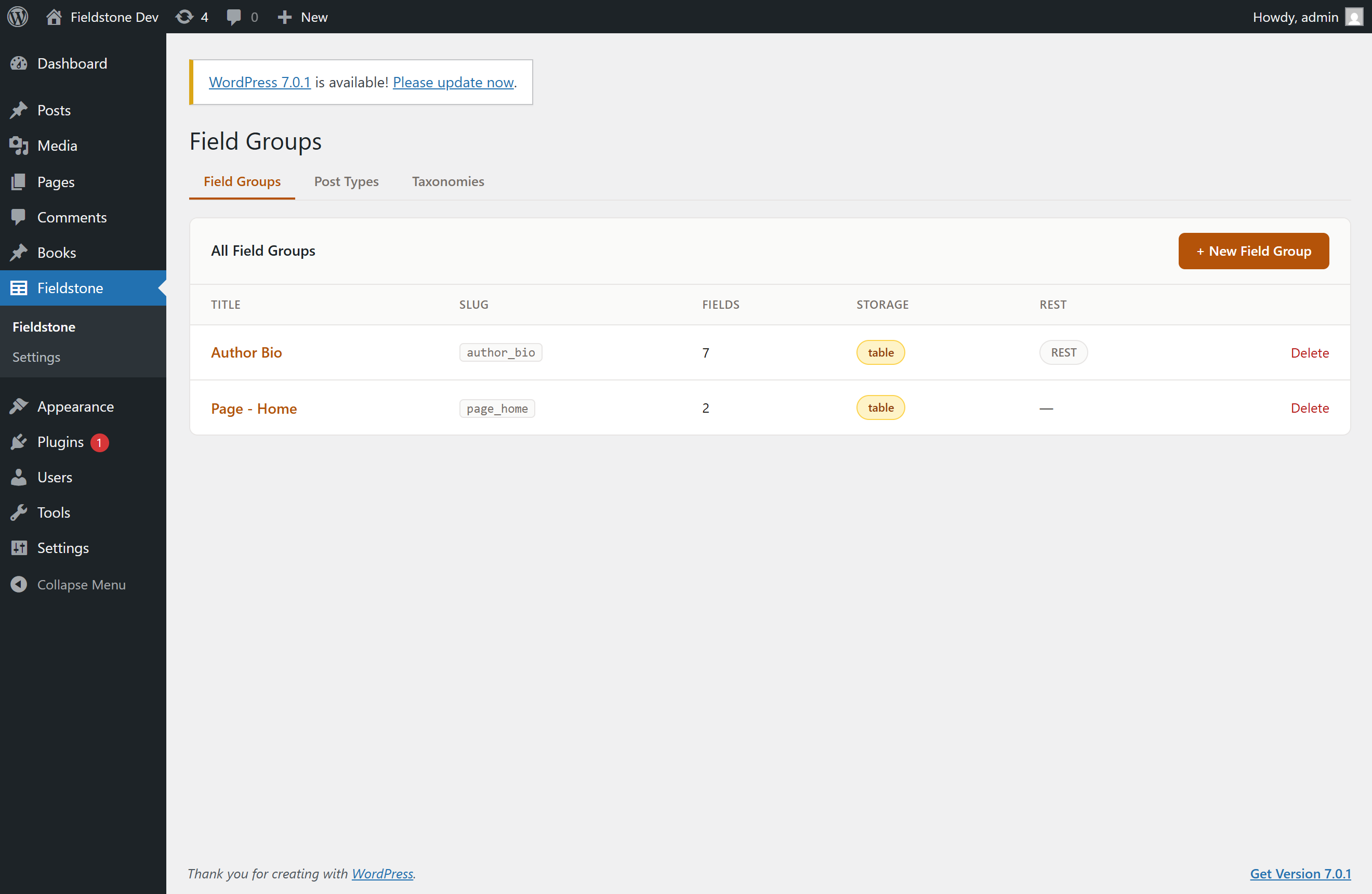
Manage all your field groups from one screen — see field counts, storage engine, and REST status at a glance.
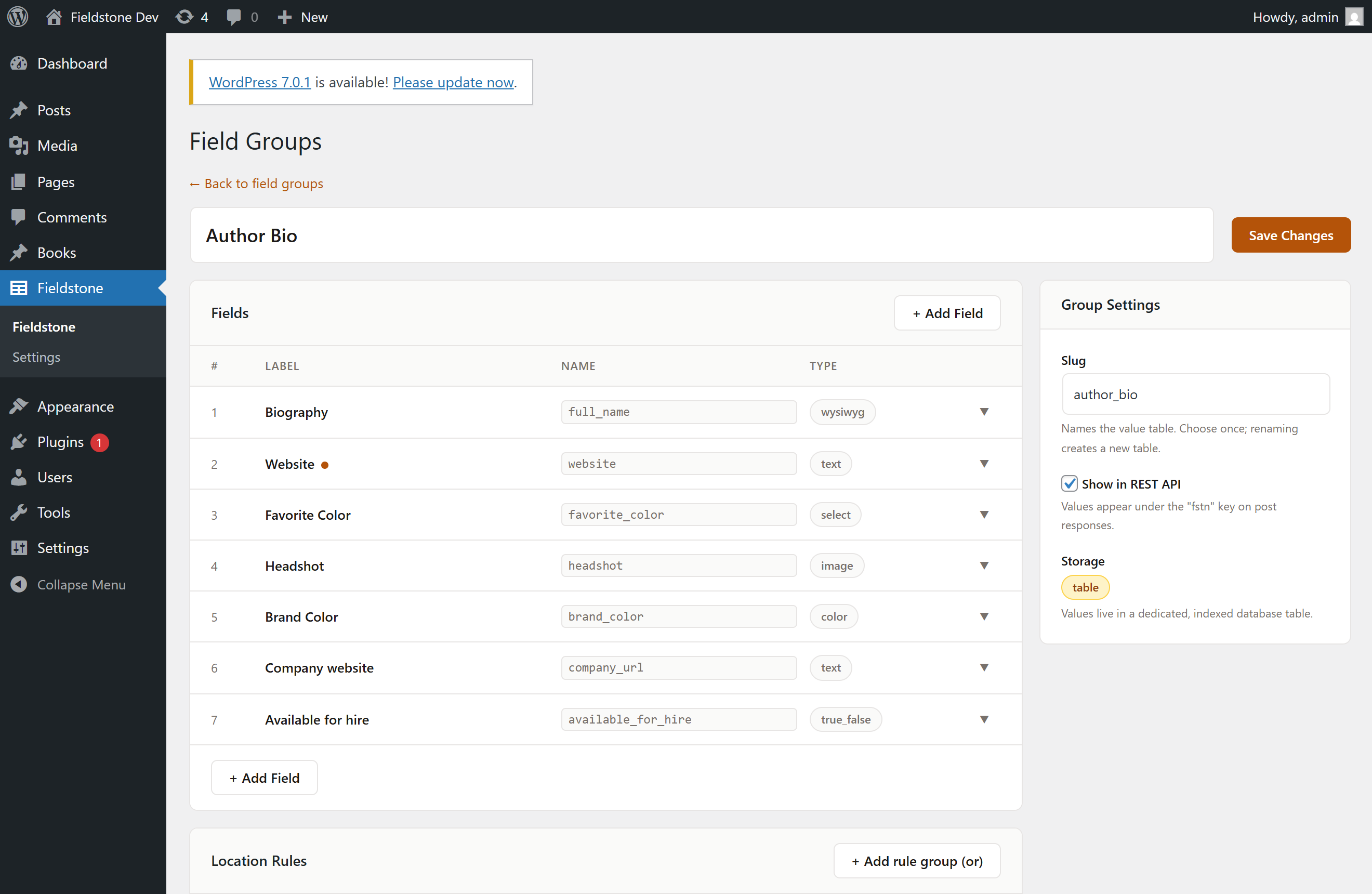
The field group editor: add fields, set per-type options, choose the storage table, and control REST exposure.
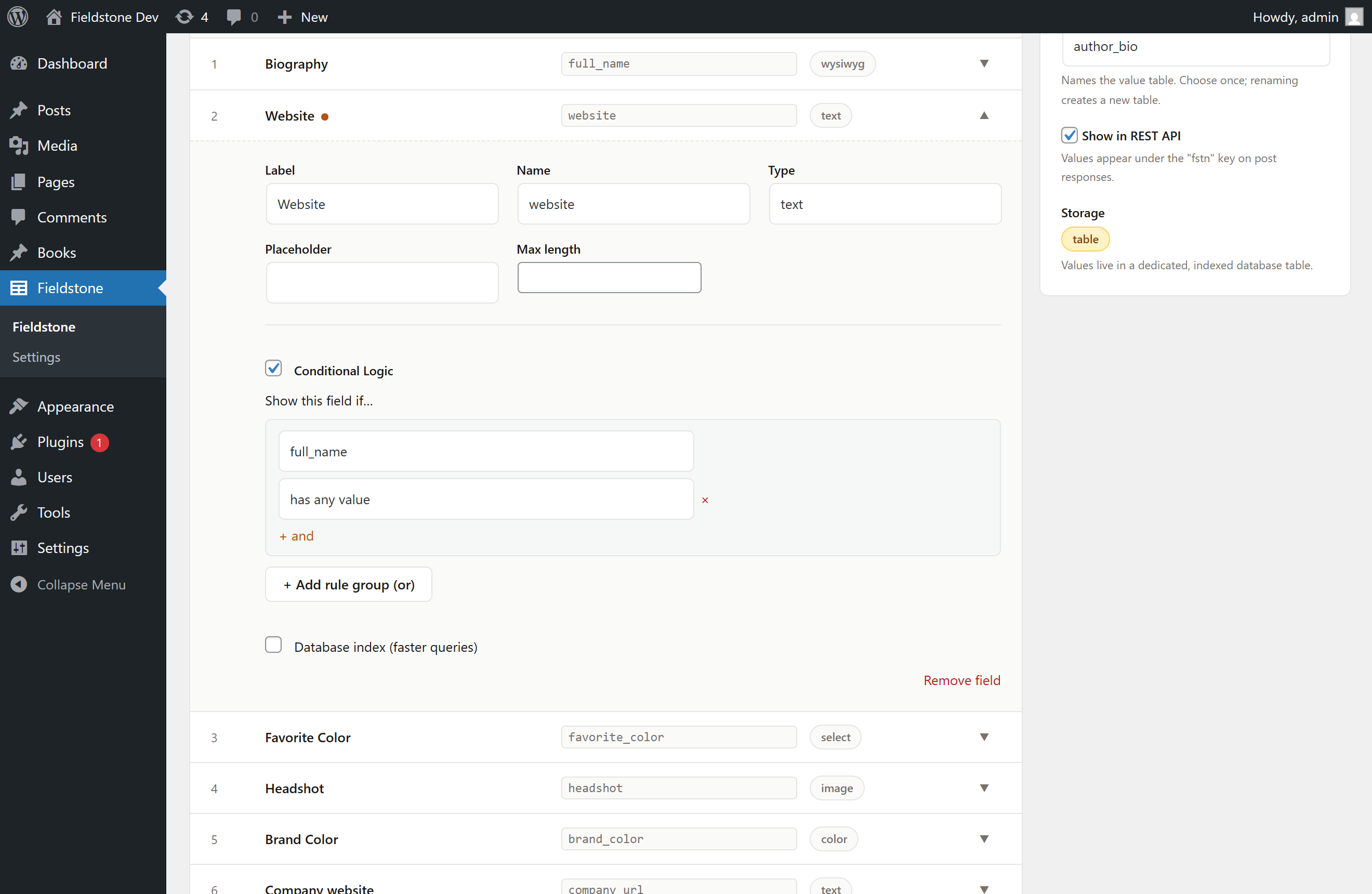
Per-field settings with conditional logic — show a field only when other fields match your rules (AND / OR groups).
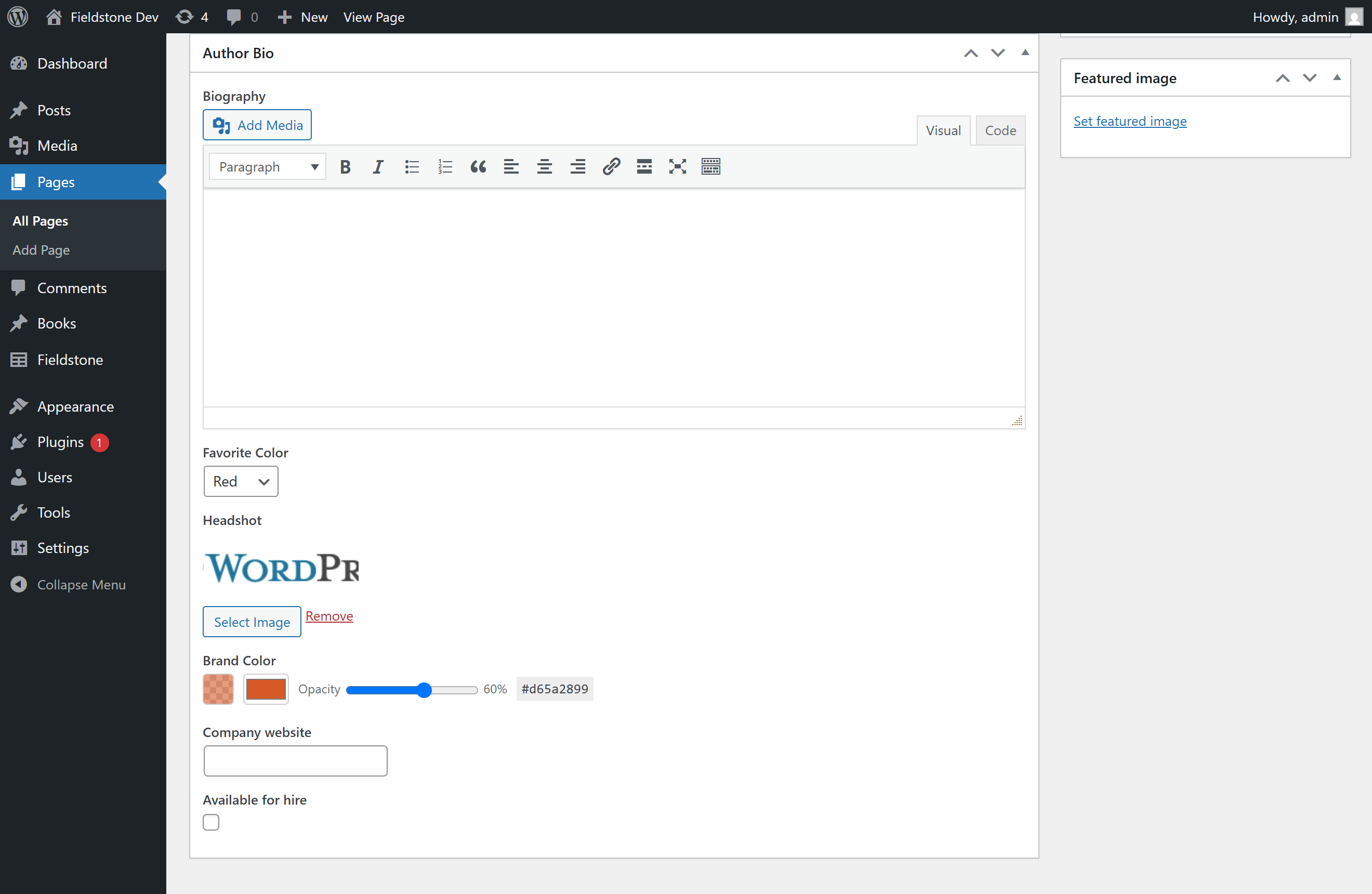
Your fields on the post editor: rich text, selects, image picker with preview, a colour picker with opacity, and more.