KPIKit – Website Audit, SEO & Revenue Fixes Wordpress Plugin - Rating, Reviews, Demo & Download
Plugin Description
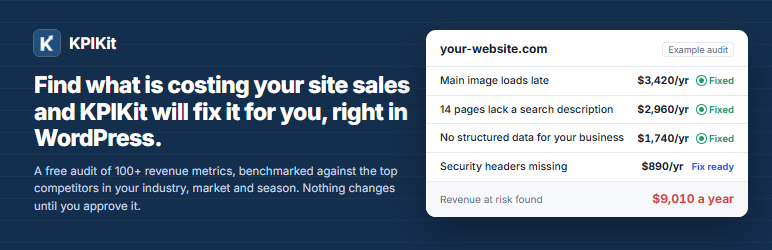
Find what is costing your website visitors and sales, and KPIKit will fix it for you, right here in WordPress.
KPIKit is a revenue-first website audit. It measures your site against 100+ revenue-focused metrics across SEO, UX/UI, content and code, and benchmarks every result against the top competitors in your industry, adjusted for your market and the current season. Each issue comes with an estimate of what it costs you every year, so you always know which fix pays back first.
Then this plugin applies the fixes you approve, inside WordPress, and KPIKit proves the result with a new audit.
Start your free audit | See what KPIKit can fix | Check your content with the AI Detector
What your free audit shows
- Your KPI score – overall and for SEO, UX/UI, content and code, each from 0 to 100.
- Competitive benchmarks – every result compared with the leading sites in your industry, for your market and season. How we measure
- Revenue at risk, issue by issue – an estimated yearly amount, a confidence level and the time each fix takes, ranked so the top of the list is always the best next step.
- Funnel leaks – every step from first visit to paying customer, measured against your industry’s benchmark.
- AI search readiness – whether Google AI Overviews, ChatGPT, Perplexity and other assistants can find, read and cite your pages. AEO/GEO Readiness
- Step-by-step instructions – plain guidance for every issue, if you prefer to fix it yourself.
Your first audit is free, takes under a minute and needs no card.
KPIKit fixes it for you, inside WordPress
Choose single fixes, a whole category pack or the fully managed service. You see the price first, then every change side by side with what is on your site today, and you accept, edit or skip each one. This plugin then applies exactly what you approved.
SEO
- Page titles and search descriptions – written around the topic of each page and, with Google Search Console connected, the searches it already appears in. Title Tags
- Structured data (schema) – tells Google and AI assistants who your business is and what it offers. Structured Data
- Internal links – links between your own pages, added inside your existing text.
- Heading hierarchy – one clear main heading per page, in the order search engines expect.
- Sitemap and search visibility – which pages are listed in your sitemap and shown in search results.
- Robots file, AI crawler rules and an /llms.txt guide – decide which search and AI crawlers may read your site. AEO Crawl Access
- Canonical tags, language labels (hreflang), redirects and clean URLs – with every old URL redirected for you.
UX/UI
- Main image loads first – for a faster Largest Contentful Paint. LCP
- Scripts load later – the ones you choose, so pages respond faster to taps and clicks.
- Image descriptions (alt text) – for screen readers, accessibility and image search.
- Heading levels in your page text – in the right order, so visitors can scan the page.
Content
- Page text – rewritten around facts your own site already states, in your voice.
- AI rewrite – paragraphs that read as AI-written are rewritten and checked again. AI Analysis
- Descriptive headings – headings that say what each section delivers.
- New pages – for the topics your site is missing, always saved as drafts for you to publish.
Code
- Security headers – HSTS, frame protection, nosniff, referrer and permissions policy, using only settings that cannot stop your pages from loading. Advanced Security
- WebP images – lighter copies served to visitors while your originals stay untouched.
AI Detector: will search engines read your content as AI?
Google’s spam policies target scaled, low-value content, and readers skip writing that feels generic. The KPIKit AI Detector shows you how your text reads before they do.
- Check any content – paste text, enter a web page or upload a file. Open the AI Detector
- See the split – how much reads as written by a person, AI-assisted or AI-generated, against the 40% line KPIKit recommends.
- See exactly why – most detectors give you a number. This one shows which sentences read as AI, why, and what to change in each.
- Have it rewritten for you – on WordPress and WooCommerce, KPIKit rewrites each flagged paragraph from facts your site already states, checks it again with the AI Detector, and you keep, edit or skip each one before anything changes. A page that makes no progress is refunded.
- Search Safe: every text KPIKit writes for your site is checked by the KPIKit AI Detector before you see it, and a text that reads as AI-written can be rewritten with facts from your own page.
- Private – texts you check are deleted after 30 days.
Proof, not promises
- Before and after – when the work is done, KPIKit audits the same pages again and shows your score before and after, for every category and every metric.
- Delivered to you – results arrive on your order page and in your inbox, ready to forward to your team or your client.
- Refund rule – if a progress fix does not move its score, that fix is refunded in full.
- One-click undo – any change can be undone from your order page for 30 days.
Safe by design
- Nothing changes without you – every change is approved by you and paid for before any work starts.
- Your sales keep running – cart, checkout, payment, login and account pages are never changed.
- Saved first – the previous version is saved before every change, and every new value is read back before KPIKit counts it as done.
- Your edits are respected – page text is only replaced if the page still holds the exact text your change was approved against. WordPress keeps a revision of every page it changes.
- Drafts stay drafts – KPIKit never publishes a page, and never removes a draft you have published.
- A full record – every change is listed under Settings > KPIKit with what was there before.
- No open door – the plugin adds no endpoint that accepts changes. It asks KPIKit for approved work with its own signed key.
Works with your setup
- Yoast SEO, Rank Math and SEOPress – titles, search descriptions, canonical tags and search visibility are written into their own fields, so your SEO plugin stays in charge.
- All in One SEO – KPIKit leaves titles, descriptions and search visibility to it, and handles the rest: structured data, page text, links, speed and security.
- No SEO plugin – KPIKit prints titles, search descriptions and canonical tags itself.
- WPML and Polylang – language labels stay with your multilingual plugin.
- WooCommerce – product pages can be improved too, while cart, checkout and account pages are never touched.
Who KPIKit is for
By team
- SEO and AEO teams – fix technical SEO and AEO/GEO issues before they cost revenue. Schema guide
- Content and geo-location teams – create AI-visible content with solid entities and structure.
- Marketing and growth – tie technical fixes directly to traffic and revenue. Revenue optimization guide
- Product and development – ship releases without breaking SEO, code or UX.
- Agencies and consultants – standardise audits and white-label reporting across all client sites. Agency guide
- Leads and RevOps – use KPIKit insights to increase leads and revenue.
By industry
- SaaS and B2B – prove SEO and AEO impact on signups and qualified leads.
- E-commerce and marketplaces – protect product visibility and fix template-wide leaks. E-commerce guide
- Fintech and banking – keep sites fast, crawlable and ready for AI answers.
- Healthcare, legal and government – improve how you appear in search and AI without breaking compliance.
- iGaming and affiliate – audit accessibility, competition and large content networks.
- Travel and real estate – fix the local and technical issues that cost bookings.
- EdTech, logistics and more – adapt KPIs, SEO and AEO to your own user journeys. Knowledge base
External services
This plugin connects to KPIKit (https://kpikit.com), the service you use to audit your site and order fixes. It is required: without it there are no fixes to apply.
- When: every five minutes while a site key is saved, when you press “Check for work now”, and once when you disconnect or delete the plugin.
- What is sent: your site URL, WordPress, PHP and plugin versions, which SEO plugin and whether WooCommerce is active, your site language, the result of each change (the old and new value of what was changed; for page text, that page’s text), and, when KPIKit asks, the names and URLs of the scripts your pages load so you can choose which to load later. Each request is signed with your site key.
- What is received: the approved changes for this site.
- Nothing is sent before you paste a site key.
- The “Start your free audit” and “See what KPIKit can fix” buttons on the settings page are ordinary links. Pressing the audit button opens kpikit.com in your browser with your site’s URL, so the audit can start; nothing is sent until you press it.
KPIKit terms of use: https://kpikit.com/terms
KPIKit privacy policy: https://kpikit.com/privacy
The plugin also offers a public, read-only URL, /wp-json/kpikit/v1/status, that reports the plugin version and whether a key is saved, so KPIKit can confirm the connection. It never reveals the key.
Screenshots

Your audit benchmarked for your industry, market and season, with a KPI score for your whole site and for SEO, UX/UI, content and code.

Every issue with its estimated yearly cost, its score and how confident the estimate is.

Your funnel against your industry’s benchmarks, step by step, with what each step could recover.

AI Analysis: how much of your writing reads as human, AI-assisted or AI-generated, and the offer to rewrite the flagged paragraphs.

Proof of what changed: your score before and after, by category and by metric (example report).

Fix it for me: choose your fixes, approve each change, and KPIKit applies them through this plugin.

Settings > KPIKit in WordPress: your connection and every change KPIKit made, with what was there before.