PSB Bot Traffic Controller Wordpress Plugin - Rating, Reviews, Demo & Download

Plugin Description
PSB Bot Traffic Controller sits in front of your WordPress site and classifies incoming traffic
into five bot categories:
- AI training bots
- AI assistants
- Autonomous AI agents
- Search engine crawlers
- Scraping agents
Each category can be configured independently to block (HTTP 403), rate-limit (HTTP 429 once
a configurable per-hour threshold is exceeded), or allow traffic. A global safety-net cap also
applies to all detected bot traffic regardless of per-category policy.
Detection runs via a free, zero-dependency regex/User-Agent pattern engine by default, curated
from third-party bot-pattern data (see Credits below). An optional WURFL.js-based detection
engine can be enabled for higher accuracy.
For performance, bot interception runs as early as possible via a small mu-plugin installed
automatically into wp-content/mu-plugins/ — this avoids the cost of a full WordPress
bootstrap for traffic that ends up being blocked.
Credits
The bundled bot-pattern data (includes/detection/regex/data/bot-patterns.php) is built from
three third-party sources, each under a GPL-compatible license:
- matomo-org/device-detector — LGPL-3.0
- crawler-user-agents — MIT
- ai.robots.txt — MIT
No code from these projects is bundled — only pattern/name/category data, transformed at build
time (tools/cmd/build-patterns) into this plugin’s own runtime format.
This plugin makes no outbound HTTP requests and does not integrate with any third-party or
external service. Earlier versions of the bundled pattern data included a per-signature
producer field (an attribution URL crediting the upstream source of each entry); it has been
removed entirely, since it was never fetched or otherwise dereferenced by the plugin at
runtime.
Screenshots
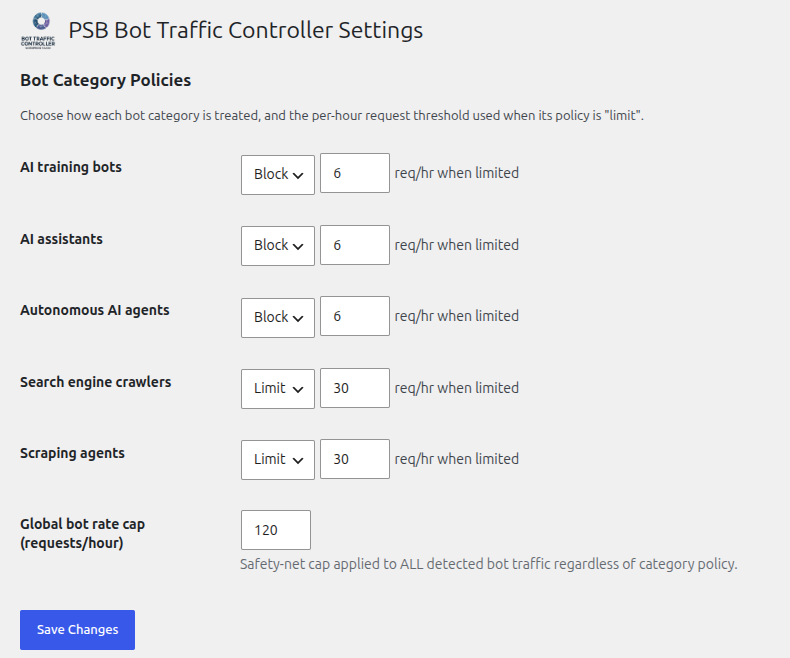
Settings page — configure block/limit/allow policy and the per-hour rate threshold for
each of the 5 bot categories, plus a global safety-net cap applied to all bot traffic.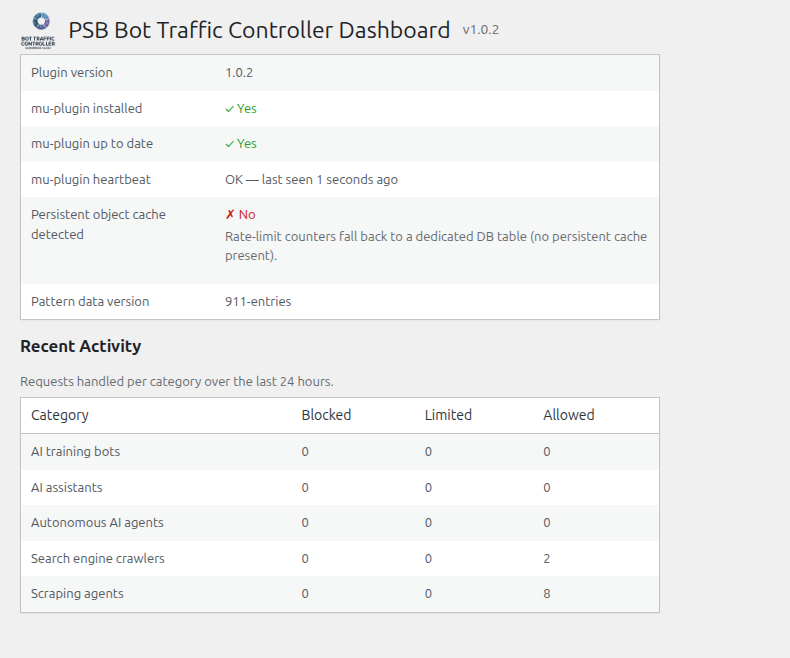
Dashboard — mu-plugin install/health status, persistent object cache detection, bot
pattern-data version, and a rolling per-category block/limit/allow activity summary.