
Simonov AI Site Manager (MCP) Wordpress Plugin - Rating, Reviews, Demo & Download
Plugin Description
Simonov AI Site Manager turns your WordPress site into a Model Context Protocol (MCP) server: one Streamable-HTTP endpoint, served by your own site, that an AI client you connect can use to work with your content.
It can manage:
- Posts, pages and any custom post type — create, read, update, delete, meta.
- Taxonomies & terms — categories, tags, custom taxonomies, term assignment.
- Media — upload from URL or base64, edit metadata, featured images.
- Comments — moderate, reply, delete.
- WooCommerce — products and order status (auto-enabled when WooCommerce is active).
- Polylang — languages, translations, linking (auto-enabled when Polylang is active).
And look up, read-only:
- Site info and navigation menus.
It does not administer the site, and it cannot be made to. There are no tools for plugins, themes, users or site settings, and every MCP request runs without administrative capabilities: managing plugins, themes, users, options or core, editing files, posting unfiltered HTML and editing theme configuration are refused for the whole request, even when the connected account is an administrator. Administration stays in the WordPress dashboard.
Every action runs as a WordPress user you choose, so capability checks are always enforced. Read-only mode, per-tool switches, revocable connections and an audit log let you decide how much of this a client can reach.
No external service
The plugin is the server and runs entirely on your site. There is no relay, account or service operated by the plugin author: the AI client you choose connects straight to your site’s REST API, and access is granted either by you signing in to WordPress and approving the client (OAuth) or by a token you generate. Tokens are stored on your site, hashed, and can be revoked at any time from the settings page.
Requirements
WordPress 5.8 or newer and PHP 7.0 or newer. Everything works the same on old and new installs.
Security
- The token is stored hashed (never in plaintext) and compared in constant time.
- Every tool enforces WordPress capabilities against the specific object it touches — not just a generic capability — so a non-admin configured user cannot edit content it does not own.
- No tool changes plugins, themes, users or site settings.
- Option reads refuse anything that looks like a credential (API keys, SMTP passwords, salts).
- Media uploads validate file content against the extension and block fetches to internal/cloud-metadata addresses.
- Disable individual tools from the settings page if you want to reduce surface area.
Note: the configured user acts with its full WordPress capabilities. Use the least-privileged role that meets your needs, and treat the token as a site credential.
Roadmap
- WPML integration.
Screenshots
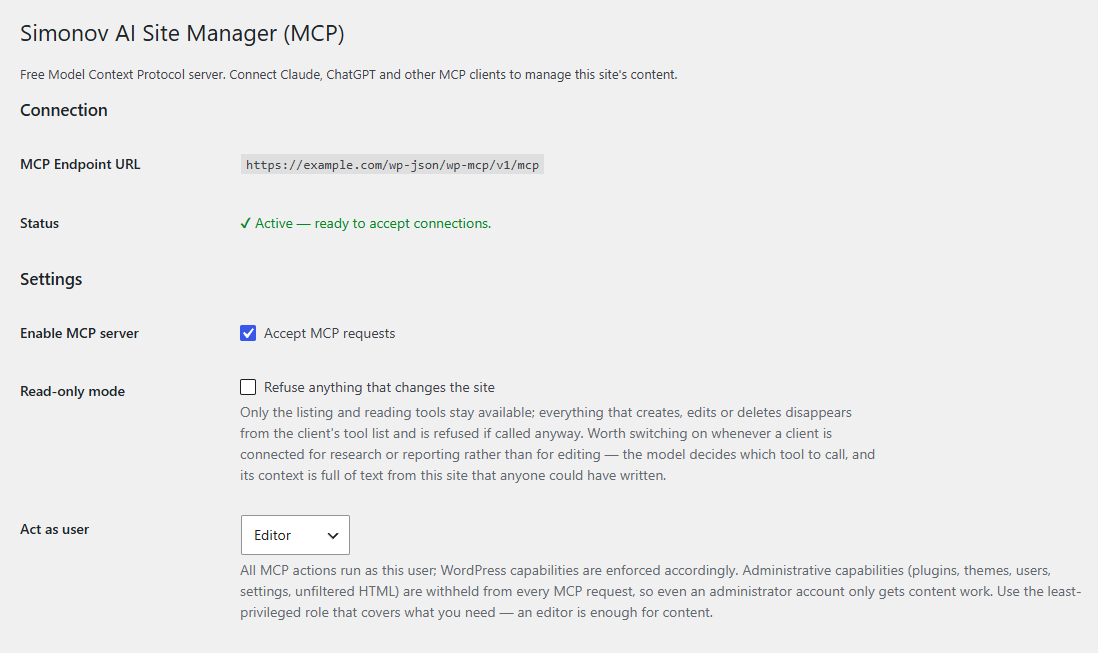
Settings: the endpoint address, the account connections act as, and read-only mode.
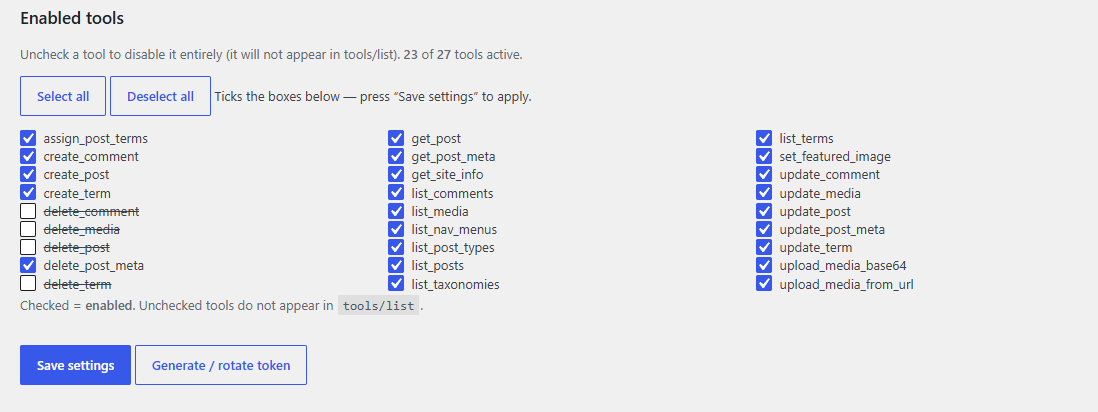
Every tool can be switched off individually; unchecked tools never appear in the client’s tool list.
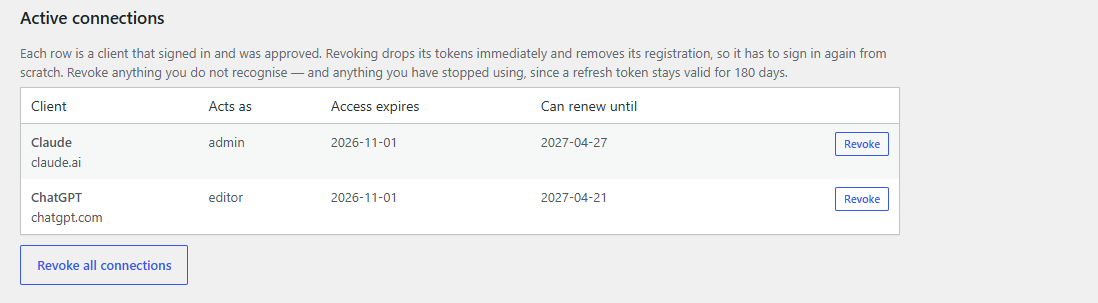
Active connections — what signed in, as whom, until when, and a Revoke button for each.
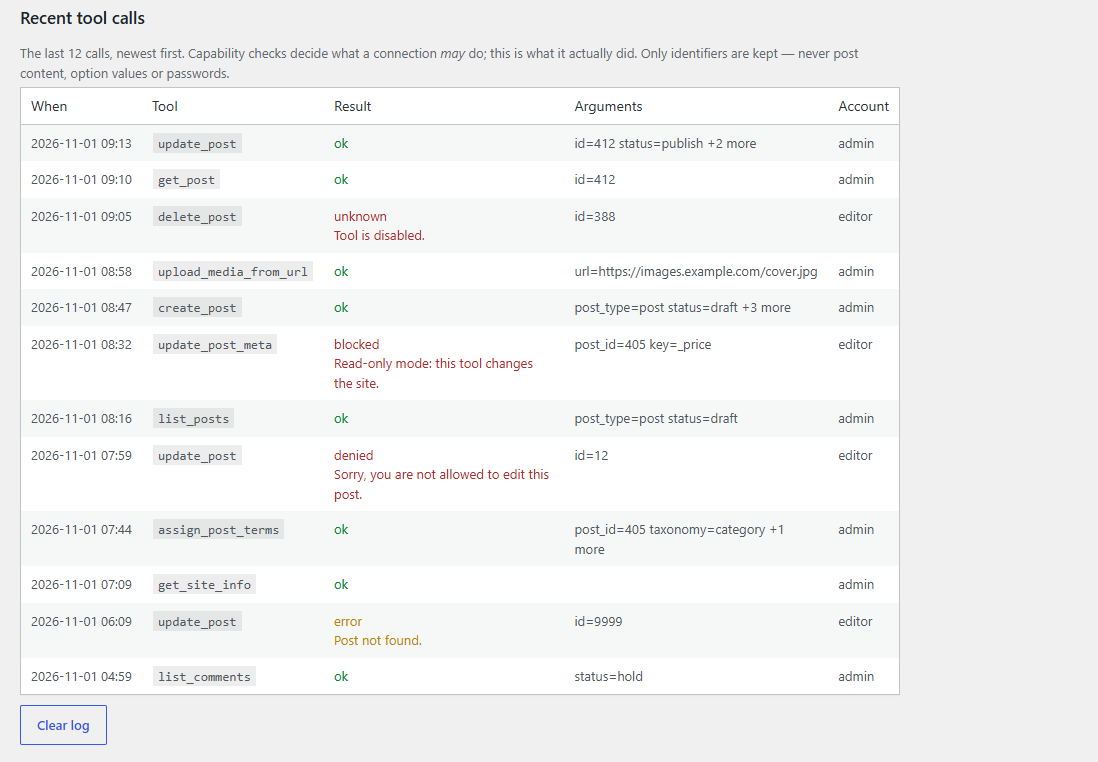
The audit log: the last hundred tool calls with their result, refusals included.


