SmartCloud Static Publisher Wordpress Plugin - Rating, Reviews, Demo & Download
Plugin Description
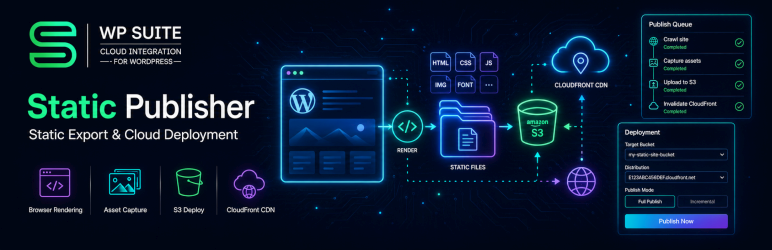
Static Publisher is a WordPress plugin + Node.js exporter workflow for deterministic static publishing.
Static Publisher is part of the WP Suite product family by Smart Cloud Solutions, Inc. WP Suite keeps WordPress as the CMS and editing layer, while optional connected features can extend selected workflows into modular AWS-backed services for identity, AI, APIs, workflows, protected routes, and static delivery. The free Static Publisher features described here do not require a WP Suite account, subscription, or WP Suite-managed AWS backend; you control any AWS credentials and target infrastructure you configure for publishing.
Project repository and extended documentation:
https://github.com/smartcloudsol/static-publisher
It is designed for setups where WordPress is the editor/origin and production is served from static hosting (for example S3 + CloudFront).
The plugin provides:
- Admin UI for export configuration
- Runtime config generation in uploads
- Job queueing (publish, crawl, deploy, invalidate, retry-timeouts, single URL)
- Run status and log viewing
The Node.js exporter provides:
- Sitemap-based discovery
- Playwright rendering for JS-heavy pages
- Asset capture from network + parsed sources
- Separate concurrency for page rendering, asset downloads, and final rewrite
- URL rewriting modes (absolute, root-relative, relative)
- S3 upload and CloudFront invalidation
- Detailed logging for crawl, deploy, and invalidate
This plugin does not execute shell commands directly from PHP.
Instead, it writes queue/config runtime files that an external Node runner executes.
This shell-first design is intentional: rendered frontend pages can be exported by Playwright/Node while WordPress/PHP remains focused on queueing and configuration.
This plugin is not affiliated with or endorsed by Amazon Web Services or the WordPress Foundation. All trademarks are property of their respective owners.
Usage Notice
SmartCloud Static Publisher does not require an external SaaS account to operate.
The plugin itself only manages configuration and queue state in WordPress.
Actual crawling and deployment are executed by your own Node runtime using this project’s exporter commands. This means:
- You control when and where exports run.
- You control AWS credentials and target infrastructure.
- WordPress/PHP does not proxy deployment traffic.
- The WordPress plugin ZIP does not bundle the Node.js exporter runtime; install
@smart-cloud/publisher-exporterseparately on the machine that processes queued jobs.
Free and Premium Usage Notice
SmartCloud Static Publisher is fully functional in Free mode and does not require a WP Suite account, subscription, trial period, or paid service to perform its core static publishing workflow.
In Free mode, the plugin supports the complete static publishing flow:
- Configure source and target settings in WP Admin.
- Queue and run full
crawl,publish,deploy,invalidate,retry-timeouts, and single-URL jobs. - Export rendered WordPress pages using the separately installed Node.js exporter.
- Capture required assets discovered during browser rendering.
- Rewrite URLs according to the configured rewrite mode.
- Deploy exported files to the configured S3 bucket.
- Create CloudFront invalidations for the configured distribution.
- View current job status and standard run logs.
Free mode includes S3 deployment and CloudFront invalidation. These are not paid-only features.
Audit Logs is also part of the main Static Publisher navigation and is not gated behind a WP Suite subscription.
The plugin package itself manages WordPress-side configuration, queue state, runtime files, and status/log access. Actual crawling and deployment are executed by the separately installed @smart-cloud/publisher-exporter CLI on the user’s own server, workstation, CI runner, or other queue-runner host.
Optional WP Suite Pro features are not required for the plugin to work. They are additional workflow, convenience, and team/enterprise publishing features. Examples may include:
- Incremental crawl / incremental publish / scheduled workflows.
- Extra Deployment Targets and Scheduler Settings backed by linked WP Suite site configuration.
- Additional team/workspace-oriented configuration features.
Extra Deployment Targets are selected by key at deploy time, while downloaded job configs keep only the base target plus an optional target override id.
These optional Pro features may be visible in the plugin interface as upgrade-only controls, but they are separate from the fully functional free static publishing workflow described above.
When no active WP Suite subscription is connected, SmartCloud Static Publisher remains usable for full static crawl/publish/deploy workflows. There is no time limit, export quota, forced trial expiry, or required payment for the core static publishing functionality.
Server Prerequisites (Node + Playwright)
The exporter requires both Node.js and Playwright browser binaries on the machine that executes queued jobs.
Recommended Node setup is NVM + latest LTS:
curl -fsSL https://raw.githubusercontent.com/nvm-sh/nvm/v0.40.3/install.sh | bash

export NVM_DIR="$HOME/.nvm" && . "$NVM_DIR/nvm.sh" && nvm ls-remote --lts && nvm install --lts && nvm use --lts
Install the standalone exporter CLI package and Chromium browser binary:
npm install -g @smart-cloud/publisher-exporter && publisher-exporter install-browsers
Important:
- If cron runs under the same OS user that installed Node and Playwright, NVM plus the default user-scoped Playwright cache is fine.
- If cron runs as a different or non-login service user such as
www-data, prefer an explicitHOME, aPATHthat already containspublisher-exporterandnode, plus a sharedPLAYWRIGHT_BROWSERS_PATH. - In crontab, prefer absolute paths instead of relying on
$HOMEexpansion inside thePATHvalue. npx playwright installis not a global install; browser binaries are user-scoped by default (usually under~/.cache/ms-playwright).- If multiple users may run jobs, use
PLAYWRIGHT_BROWSERS_PATHto point to a shared browser folder and grant proper permissions. - If the shared browser directory lives under a protected system path, create it once with elevated privileges and make it writable by the same OS user that will run
publisher-exporter install-browsers. The later cron job only needs read/execute access to that directory tree. - For internal/self-signed TLS origins, enable
Allow self-signed TLS certificates during crawlin the admin UI (config key:ignoreHttpsErrors).
If you prefer a shared browser cache for a non-login service user such as www-data, create the shared directory once, hand it to the job user, then install browsers from the CLI package without keeping the browser cache root-owned:
sudo mkdir -p /var/lib/playwright-browsers && sudo chown "$USER":"$USER" /var/lib/playwright-browsers && PLAYWRIGHT_BROWSERS_PATH=/var/lib/playwright-browsers /usr/bin/npx @smart-cloud/publisher-exporter install-browsers<h3>Run A Queued Job From Another Machine</h3>
If the WordPress host cannot run Node, Playwright, or cron, you can replay a queued job from your own shell or CI machine.
- In the Job Queue panel click
Download confignext to the queued job and save the file asqueued-job.json. - Extract the nested
publisherConfigobject topublisher.config.jsonusing one of the commands already included in the downloaded file undermanualExecution.commands. - Install
@smart-cloud/publisher-exporteron that machine first. - Optionally edit
publisher.config.jsonlocally, for example to changeoutputDirto a writable local folder. - Run the exact command from
manualExecution.commands.jobPosixormanualExecution.commands.jobPowerShell. - If you also want to deploy from your own machine, continue with the provided
deploySdkandinvalidateSdkcommands from the samemanualExecution.commandsblock.
Important:
- This is an out-of-band replay of the queued job and does not mark the WordPress queue item as completed automatically.
- If the original queued item should not run later on the server, remove or clean it up in WordPress after your manual replay.
- The WordPress plugin ZIP does not contain the exporter runtime. Install
@smart-cloud/publisher-exporterseparately on the machine that replays the downloaded job.
Shared Runtime Across Two Hosts
SmartCloud Static Publisher can run with WordPress on one machine and the queue runner on another, as long as both machines point to the same shared wp-content/uploads/smartcloud-static-publisher storage.
Example:
- WordPress host sees the storage at
/var/www/site/wp-content/uploads/smartcloud-static-publisher - Queue runner host mounts the same storage at
/mnt/site - Queue runner uses
STATIC_PUBLISHER_RUNTIME_DIR='/mnt/site/runtime'
Recommended rules for this setup:
- Keep
outputDirandlogDirstorage-relative in admin, for exampleexportandlogs, not machine-specific absolute paths. - Use
@storage-rootinpostCrawlCopyMapwhen the source files are already inside the shared publisher storage. - Use
@wp-rootonly when the queue runner host can also access the WordPress tree, and setSTATIC_PUBLISHER_WP_ROOT(orWPSUITE_STATIC_PUBLISHER_WP_ROOT) on that host. @runtimepoints to the shared runtime folder itself.
Example postCrawlCopyMap sources:
@storage-root/shared-assets/@wp-root/wp-content/uploads/smartcloud-static-publisher/
If you inspect the raw queue-runner-heartbeat.json, the runtimeDir and exporterDir values reflect the queue runner host paths. That is expected and does not break WordPress-side queue state handling.
Machine-readable resources
- Plugin manifest: https://wpsuite.io/.well-known/ai-plugin.json
- OpenAPI spec (backend): https://wpsuite.io/.well-known/openapi.yaml
External Services
This plugin/workflow may integrate with the following external services, depending on configuration:
-
Source WordPress origin and allowed asset hosts (required for crawl/export)
- What it is & what it’s used for:
The configured source origin and allowed asset hosts are fetched during crawl/render to collect pages and assets for static export. - What data is sent & when:
Standard HTTP(S) requests from the exporter to source pages/assets. Request data typically includes normal browser request metadata (URL, headers, cookies/session context if your source site requires it). - Where it goes:
sourceOrigin and hostnames listed inallowedAssetHosts.
- What it is & what it’s used for:
-
Amazon S3 (optional; deploy command)
- What it is & what it’s used for:
Object storage target for exported static files. - What data is sent & when:
Exported HTML/assets plus object metadata (content type, cache-control) whendeployruns. - Where it goes / API usage:
AWS S3 APIs via AWS SDK (PutObject,ListObjectsV2,DeleteObjects) to your configured bucket/region. - Links:
- AWS Service Terms: https://aws.amazon.com/service-terms/
- AWS Privacy: https://aws.amazon.com/privacy/
- What it is & what it’s used for:
-
Amazon CloudFront (optional; invalidate command)
- What it is & what it’s used for:
CDN invalidation after deployment. - What data is sent & when:
Invalidation path list and distribution identifier wheninvalidateruns. - Where it goes / API usage:
AWS CloudFront API via AWS SDK (CreateInvalidation) for your configured distribution. - Links:
- AWS Service Terms: https://aws.amazon.com/service-terms/
- AWS Privacy: https://aws.amazon.com/privacy/
- What it is & what it’s used for:
-
WP Suite platform connection (optional; site/workspace linking & shared features)
- When it applies:
When you use WP Admin SmartCloud Connect your Site to WP Suite to link this WordPress site to a WP Suite workspace, or to switch/disconnect later. - What it’s used for:
Storing and retrieving Pro feature configuration (e.g., API/chatbot/feature settings) and enabling an admin-side preview experience so you can try Pro features in WP Admin before enabling them on the live site. - What data may be sent:
Minimal account/session data required for authentication, and minimal site/workspace linking data required to associate a WordPress site with a workspace (e.g., site/workspace identifiers and the site’s URL/domain). - Where it goes / how it’s called:
Secure HTTPS requests from the browser to WPSuite.io services (e.g. wpsuite.io and api.wpsuite.io). - Links:
- WPSuite.io Privacy Policy: https://wpsuite.io/privacy-policy
- WPSuite.io Terms of Use: https://wpsuite.io/terms-of-use
- When it applies:
-
Amazon Cognito (optional; authentication for WP Suite Hub and/or protected APIs)
- When it applies:
- When using the WP Suite Hub, users authenticate (sign in / sign up) before creating/selecting a workspace and linking a site.
- If a plugin is configured to access protected endpoints that rely on Cognito, authentication/token flows may also be used for those requests.
- What it’s used for:
User authentication and token-based authorization for subsequent API calls (e.g., to WPSuite.io APIs). - Links:
- AWS Service Terms: https://aws.amazon.com/service-terms/
- AWS Privacy: https://aws.amazon.com/privacy/
- When it applies:
-
Stripe (optional; subscription/purchase flow)
- When it applies: Only when the user opens the optional WP Suite subscription / purchase flow in the shared admin component.
- What it’s used for: Displaying hosted pricing/subscription UI for optional paid features.
- What data may be sent: Browser/session data required by Stripe to render the hosted purchase UI and process the purchase flow.
- Links:
- Terms: https://stripe.com/legal/consumer
- Privacy: https://stripe.com/privacy
Example IAM Role Profiles
Adjust values before use (YOUR_BUCKET, YOUR_PREFIX, YOUR_ACCOUNT_ID, YOUR_DISTRIBUTION_ID).
Command-to-profile mapping:
deploy->deploy-onlyinvalidate->deploy+invalidate-
publish->deploy+invalidatedeploy-only policy (S3 only):
{
“Version”: “2012-10-17”,
“Statement”: [
{
“Sid”: “ListOnlyTargetPrefix”,
“Effect”: “Allow”,
“Action”: [“s3:ListBucket”],
“Resource”: “arn:aws:s3:::YOUR_BUCKET”,
“Condition”: {
“StringLike”: {
“s3:prefix”: [“YOUR_PREFIX/“]
}
}
},
{
“Sid”: “RWOnlyTargetPrefixObjects”,
“Effect”: “Allow”,
“Action”: [
“s3:GetObject”,
“s3:PutObject”,
“s3:DeleteObject”,
“s3:AbortMultipartUpload”,
“s3:ListBucketMultipartUploads”,
“s3:ListMultipartUploadParts”
],
“Resource”: “arn:aws:s3:::YOUR_BUCKET/YOUR_PREFIX/”
}
]
}deploy+invalidate policy (S3 + CloudFront invalidation):
{
“Version”: “2012-10-17”,
“Statement”: [
{
“Sid”: “ListOnlyTargetPrefix”,
“Effect”: “Allow”,
“Action”: [“s3:ListBucket”],
“Resource”: “arn:aws:s3:::YOUR_BUCKET”,
“Condition”: {
“StringLike”: {
“s3:prefix”: [“YOUR_PREFIX/“]
}
}
},
{
“Sid”: “RWOnlyTargetPrefixObjects”,
“Effect”: “Allow”,
“Action”: [
“s3:GetObject”,
“s3:PutObject”,
“s3:DeleteObject”,
“s3:AbortMultipartUpload”,
“s3:ListBucketMultipartUploads”,
“s3:ListMultipartUploadParts”
],
“Resource”: “arn:aws:s3:::YOUR_BUCKET/YOUR_PREFIX/”
},
{
“Sid”: “InvalidateSpecificDistribution”,
“Effect”: “Allow”,
“Action”: [“cloudfront:CreateInvalidation”],
“Resource”: “arn:aws:cloudfront::YOUR_ACCOUNT_ID:distribution/YOUR_DISTRIBUTION_ID”
}
]
}Trademark Notice
Amazon Web Services, AWS, Amazon S3, and Amazon CloudFront are trademarks of Amazon.com, Inc. or its affiliates.
SmartCloud Static Publisher is an independent project and is not affiliated with, sponsored by, or endorsed by Amazon Web Services or the WordPress Foundation.
Source & Build
Public source code:
The project source is maintained by Smart Cloud Solutions, Inc.
Build and distribution:
SmartCloud Static Publisher is shipped to WordPress.org as a pre-built distribution.
Build steps and development notes are documented in the repository README.
Screenshots

Static Publisher admin dashboard

Core export configuration panel

S3 and CloudFront settings

Job queue and command selection

Runtime logs viewer