Titula Wordpress Plugin - Rating, Reviews, Demo & Download
Plugin Description
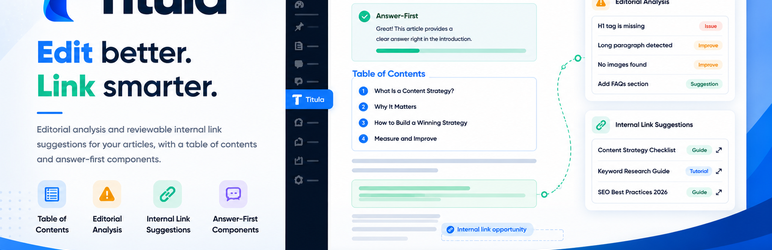
Most plugins in this space stop at generating a table of contents. Titula
starts there and then does the two things that actually take an editor’s time:
it tells you what is structurally wrong with an article, and it finds places
where your articles could link to each other.
What makes it different
Editorial Readiness. Open a post and Titula reports five dimensions —
Answer Clarity, Content Structure, Reader Experience, Internal Linking, Search
and AI Readiness — with a plain sentence and a short list of what to fix. It
names specific problems: a skipped heading level, an introduction that buries
the answer, a section running long without a subheading, images missing
dimensions. There is no word-count target, no keyword density and no keyword
repetition in the model, because none of those measure whether an article is
good.
Internal link suggestions you approve. Titula reads your published articles
and finds places where one could link to another. Each suggestion shows the
source, the destination, the sentence around it, a score and the reason. You
accept or ignore it.
Accepting one never rewrites your post. The decision is stored and the link is
applied when the page renders, so your content stays exactly as you wrote it
and any choice can be undone. The anchor is always a phrase your article
already contains — nothing is reworded, and no keyword is forced in. Links are
never placed inside existing links, headings, code or captions.
Arabic and RTL, handled properly
Measurement built for the Latin alphabet gives wrong answers in Arabic, and
most plugins never notice. PHP’s own str_word_count() returns zero for Arabic
text, so reading times on Arabic sites are frequently nonsense.
Titula counts by Unicode word boundaries, strips diacritics and the tatweel
before measuring since neither is a letter, discards punctuation-only tokens,
and times Arabic and Latin words at separate adjustable speeds. Heading anchors
stay readable in Arabic instead of collapsing into numbered fragments.
Three optional extras for Arabic publishers:
- Latin permalink suggestions. WordPress percent-encodes Arabic slugs, so a
title becomes a URL of the form%d8%a7%d9%84. Valid, but unreadable once
copied, printed or read aloud. Titula suggests a transliteration in the
editor with a checkbox to apply it, warns you when the post is published and
changing it would break existing links, and never changes anything on its
own. Arabic permalinks are a legitimate choice. - Hijri dates, shown beside the Gregorian date rather than replacing it.
The machine-readable date in the markup stays Gregorian, as the HTML
specification requires. Where theintlextension is available the Umm
al-Qura calendar is used; otherwise a tabular calculation, which can differ
from an announced date by a day, so a manual adjustment is provided. - Arabic typography. Raises line height, which the script needs because
letters carry taller ascenders and deeper descenders and diacritics sit above
and below the line. Just as importantly it resetsletter-spacing: Arabic
letters join, and spacing them apart pulls the joins open. Themes designed
for Latin text set letter-spacing on headings routinely, and it looks correct
in their previews because those previews are in English.
Reading experience
- Table of contents from your H2 and H3 headings, with stable anchors that stay
readable in Latin, Arabic and accented scripts. Long lists collapse behind a
“View all sections” control. - Quick Answer, Key Takeaways and Article Summary, shown above the table of
contents so a reader who wants only the answer finds it first. - FAQ, facts, pros and cons, steps, checklist, related reading and an author
box. Every component optional; one with an empty field renders nothing. - Tables that take their colours from your theme’s own palette rather than
imposing a second one, and that reorganise on a phone instead of asking the
reader to drag them sideways. A table of three to seven columns becomes one
card per row, each value labelled with its own column heading. Very wide
reference tables keep their scroll, because a card that long stops being
readable. Nothing is ever hidden: a phone reader sees exactly what a desktop
reader sees.
Everything is free
There is no paid version, no upsell, no locked feature and no account.
Performance
- Rendered articles are cached and reused until the post or a setting changes.
- Content analysis is manual, batched and resumable. It never runs on a visitor
request. Also available aswp titula scan. - Stylesheets load only on singular views of a supported post type, split so a
post with no tables never downloads the table rules. The script loads only
when the article actually has a table of contents or images. - No external requests, no tracking, no jQuery.
Articles built as raw HTML are left alone
If you publish some articles as a complete, self-contained HTML layout pasted
into a Custom HTML block, Titula detects them and does nothing to them at all:
no table of contents, no heading anchors, no components, no wrapper, and not
even a stylesheet request.
Detection is deliberately cautious, since wrongly skipping an ordinary article
is far worse than wrongly processing one. It looks for signals an ordinary post
never produces: a style element in the content, most of the article sitting
inside Custom HTML blocks, or heavy inline styling. A long article containing
one small embed block is not affected.
Every post also carries a Processing control in the editor, in both the block
and classic editors, so you can force either answer. Excluded articles are
still valid destinations for links from elsewhere: leaving an article alone
means not modifying it, not refusing to point at it.
What Titula does not do
- It writes no SEO title, meta description, canonical URL or robots directive.
- It produces no structured data, and never modifies schema from another plugin.
- It generates no text and contacts no external service or AI model.
- It cannot promise a ranking, a Google AI Overview placement or a citation in
any AI assistant. No plugin can, and this one does not claim to. - It styles nothing outside the article container, so your theme is untouched.
Screenshots
No screenshots provided