CrawlSage Wordpress Plugin - Rating, Reviews, Demo & Download
Plugin Description
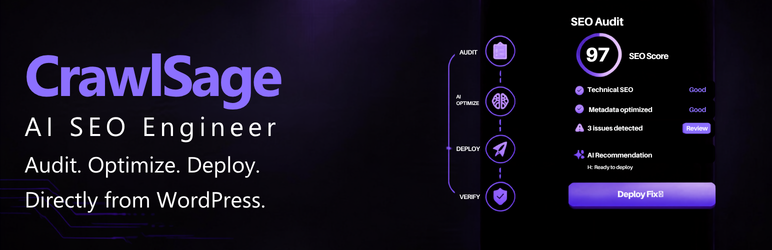
CrawlSage helps you discover SEO issues across your WordPress website, review actionable recommendations, apply supported optimizations, and track what changed.
Connect your WordPress website to your CrawlSage account and manage the SEO workflow from discovery through deployment.
What can CrawlSage do?
CrawlSage supports:
- Discovering WordPress URLs and supported content types.
- Running SEO audits for supported pages and content.
- Identifying technical and on-page SEO issues.
- Reviewing SEO recommendations before making changes.
- Optimizing SEO titles and meta descriptions.
- Managing focus keyword recommendations.
- Reviewing and applying image alt text recommendations.
- Tracking applied fixes and deployment history.
- Verifying supported changes after deployment.
- Rolling back supported optimizations.
- Viewing connection and diagnostic information.
CrawlSage does not automatically apply SEO changes without an authorized workflow. Supported changes are reviewed and authorized by a WordPress administrator before deployment.
A CrawlSage account and connection to the CrawlSage service are required to use cloud-powered features.
How it works
- Connect your WordPress website to CrawlSage.
- Discover the URLs and supported content on your website.
- Run an SEO audit.
- Review detected issues and recommendations.
- Approve the optimizations you want to apply.
- Deploy supported changes to WordPress.
- Verify the result and review fix history.
- Roll back supported changes when necessary.
Secure connection
CrawlSage uses an OAuth connection. The administrator is redirected to the CrawlSage app to authenticate. The browser receives only a short-lived authorization code and state value. WordPress exchanges the authorization code directly with the CrawlSage API.
Long-lived authentication tokens are not transported through browser URLs.
Authenticated credentials stored by the plugin are protected using the plugin’s credential storage mechanism and WordPress security keys.
External services
CrawlSage is a SaaS-connected plugin and requires communication with the CrawlSage service.
API service:
https://api.crawlsage.com
Web application:
https://app.crawlsage.com
A CrawlSage account is required to use the connected SEO audit, recommendation, deployment, verification, credit, and account features.
Connection data
When an administrator starts or completes a CrawlSage connection, the plugin may send:
- Site URL and hostname.
- WordPress version.
- PHP version.
- CrawlSage plugin version.
- WordPress timezone.
- CrawlSage site or installation identifier.
- Administrator email when supplied as part of the connection workflow.
- OAuth authorization code and state during the connection workflow.
This information is used to authenticate and associate the WordPress website with the appropriate CrawlSage account.
Discovery and audit data
When an administrator performs discovery or starts an audit, the plugin may send information required to analyze supported WordPress content, including:
- Page and content URLs.
- WordPress object IDs and object types.
- Content and URL inventory metadata.
- Indexability and editability information.
- SEO titles and meta descriptions.
- Focus keyword information.
- Heading information.
- Canonical and robots information.
- Structured-data information where supported.
- Image and alt-text metadata.
- Audit results and detected SEO issues.
- Relevant timestamps and processing status.
This information is used to discover content, evaluate supported SEO issues, and produce audit results.
Recommendation data
When recommendations are generated or retrieved, CrawlSage may process:
- Issue identifiers.
- Affected URLs and WordPress objects.
- Existing SEO values.
- Recommended values.
- Priority and confidence information.
- Related audit metadata.
This information is used to generate and manage SEO recommendations.
Deployment, verification, and rollback data
When an administrator applies, verifies, or rolls back a supported optimization, the plugin may send:
- Recommendation or fix identifiers.
- Target WordPress object information.
- Selected or applied values.
- Previous values where required for verification or rollback.
- Operation status.
- Relevant timestamps.
- Error information required to diagnose a failed operation.
This information is used to apply authorized changes, verify their status, maintain fix history, and support rollback.
Credits and account status
When CrawlSage needs current account or usage information, the plugin may send the authenticated site/account identifier and request information such as:
- Available credits.
- Plan status.
- Usage eligibility.
Payment-card and payment-processing details are not stored by this WordPress plugin.
When data is sent
The plugin does not initiate CrawlSage service requests before an administrator starts the connection process.
After connection, requests may occur when an administrator uses CrawlSage features or when an enabled CrawlSage background process performs a connected synchronization or status operation.
The plugin does not send WordPress passwords to CrawlSage.
CrawlSage does not use an external executable-code update system for this plugin. Plugin updates distributed through WordPress.org use the standard WordPress.org plugin update mechanism.
CrawlSage processes transmitted information according to its privacy and data-retention practices.
Privacy Policy:
https://crawlsage.com/legal/privacy-policy
Terms of Service:
https://crawlsage.com/legal/terms-of-service
Data handling
The plugin stores connection state and authenticated credentials in WordPress options.
Operational information related to discovered URLs, audits, fixes, history, and diagnostics may be stored in CrawlSage custom database tables.
Sensitive authentication credentials are stored using CrawlSage’s protected credential-storage mechanism.
Deactivation
Deactivating CrawlSage:
- Preserves plugin settings and operational data.
- Preserves the existing connection so the plugin can resume after reactivation.
- Removes or clears CrawlSage scheduled events as required by the plugin lifecycle.
Uninstall
When CrawlSage is uninstalled:
- Authentication credentials are removed.
- Connection settings are removed.
- Security-related transients are removed.
- CrawlSage plugin options are removed.
CrawlSage custom database tables are retained by default.
If Delete CrawlSage data on uninstall is enabled before uninstalling the plugin, CrawlSage custom database tables are also removed.
Screenshots

CrawlSage dashboard with SEO health, audit status, recommendations, and website overview.

Select WordPress content and start a cloud-powered SEO audit.

Follow live crawl and SEO audit progress directly inside WordPress.

Review AI-powered SEO recommendations before deployment.

Deploy approved SEO optimizations directly to WordPress and track applied changes.