Driveline Core Wordpress Plugin - Rating, Reviews, Demo & Download

Plugin Description
Driveline Core provides the content types and booking logic for vehicle rental
sites. It works with any theme, and the data belongs to the plugin rather than
to the theme, so changing how the site looks never puts a reservation at risk.
What it registers
Vehicles, locations, packages, extras, bookings and enquiries, each as its own
content type, plus taxonomies for make, vehicle type, fuel, transmission and
features. Everything is prefixed, so nothing collides with another plugin.
Availability and booking
A vehicle has a number of units, and availability is counted against those units
across a half-open date window, so a rental ending exactly when another starts is
not a conflict. A booking takes a hold first, and the hold is what reserves the
unit while the customer finishes paying. Two customers reaching the last car at
the same moment cannot both take it: the claim is made behind a named database
lock and re-checked after it is written.
Holds expire. An unpaid booking releases its units on a scheduled sweep so a
car does not sit reserved for someone who never came back.
Pricing
Rates are per vehicle with rules layered over them: seasonal percentages,
weekday surcharges, long rental discounts, driver age bands, delivery, one way
returns, add-ons and damage protection tiers. Money is stored in minor units
against a declared currency, so a rounding error cannot creep in between the
quote a customer saw and the amount an operator collects.
Checkout
WooCommerce is optional. With it installed, a booking is paid through a normal
WooCommerce order, which brings refunds, taxes, gateways and reporting with it.
Without it, a booking is still placed, still holds its units and is still
confirmed by an operator.
Customer accounts and operator screens
Customers see their rentals, ask to change dates and download their documents
through a signed link that expires rather than a guessable path. Operators get a
month-by-month fleet calendar and the booking list on the same dashboard, and
pricing rules, submitted listings and notification settings under the Fleet
menu.
Search and maps
Visitors filter the fleet by dates, location, vehicle type and features. Maps
are off until you turn them on, and every service the plugin can contact is
listed below.
External services
This plugin can contact the services below. All of them are switched off when
the plugin is installed, and none is contacted until an administrator turns it
on under Fleet, Maps.
OpenStreetMap tile servers
Used to draw the map images on any page showing a map. When maps are switched
on, each visitor’s browser requests map tiles directly from
https://tile.openstreetmap.org/{z}/{x}/{y}.png. Those requests carry the
visitor’s IP address, their browser’s user agent, and the area of the map being
viewed. No personal data is sent by this plugin.
Turning maps off in the settings stops the requests entirely: the map area shows
a short notice instead and no tile is ever requested.
Service provided by the OpenStreetMap Foundation.
Terms: https://osmfoundation.org/wiki/Terms_of_Use
Tile usage policy: https://operations.osmfoundation.org/policies/tiles/
Privacy policy: https://osmfoundation.org/wiki/Privacy_Policy
Nominatim geocoding
Used to turn an address typed into a vehicle or branch into map coordinates.
When address lookup is switched on, this site’s server sends the address, and a
contact address you configure, to https://nominatim.openstreetmap.org/search.
Turning a dragged map pin back into an address uses
https://nominatim.openstreetmap.org/reverse the same way. Nothing is sent from
a visitor’s browser.
Every result is stored permanently, so an address is looked up once and never
again, and lookups are paced at one per second as the service requires.
Service provided by the OpenStreetMap Foundation.
Terms: https://osmfoundation.org/wiki/Terms_of_Use
Usage policy: https://operations.osmfoundation.org/policies/nominatim/
Privacy policy: https://osmfoundation.org/wiki/Privacy_Policy
Mapbox
Optional, and used only if you select Mapbox as the tile provider and save a
public access token.
For map images, each visitor’s browser requests raster tiles from
https://api.mapbox.com/styles/v1/{style}/tiles/512/{z}/{x}/{y}, where the style
is the one you selected. Those requests carry the visitor’s IP address, their
browser’s user agent, the area of the map being viewed, and your public access
token. The token is public by design and is visible in the page source, so
restrict it to your site’s URL in your Mapbox account.
For address lookup, if you also select Mapbox as the geocoding service, this
site’s server sends the address to
https://api.mapbox.com/search/geocode/v6/forward, and a dragged map pin to
https://api.mapbox.com/search/geocode/v6/reverse. By default Mapbox returns
temporary results that may not be stored, so nothing is cached and every changed
address costs another lookup. Results are cached only when you tick the setting
declaring that your account is entitled to permanent geocoding, which sets the
permanent parameter on the request.
Service provided by Mapbox, Inc.
Terms: https://www.mapbox.com/legal/tos
Privacy policy: https://www.mapbox.com/legal/privacy
Attribution requirements: https://docs.mapbox.com/help/dive-deeper/attribution/
Privacy
A booking holds the customer’s name, email address, telephone number and any
notes they left, together with the dates, the branches, the vehicle and the
price agreed. All of it stays in this site’s database. The plugin sets no cookie
of its own, writes nothing to a visitor’s browser, and sends no personal data to
any external service; the services listed above receive an address to geocode or
a map area to draw, never a customer.
Rental data is reported and cleared through the privacy tools WordPress already
has, under Tools, Export Personal Data and Tools, Erase Personal Data. A
customer can raise the same request from their own dashboard, and the button
there raises a core request rather than acting on the spot, so the link
WordPress emails has to be opened before anything is exported or destroyed. A
dashboard left open on a shared machine is not enough.
Erasure takes the name, email address, telephone number and notes off the
rentals and keeps the rentals. A booking is a commercial record with an invoice
number against it, and the right to erasure does not reach the ledger a tax
authority can ask about. The erasure screen says exactly that, rather than
reporting a clean job it did not do.
Resources
Leaflet 1.9.4
Copyright (c) 2010-2023 Volodymyr Agafonkin, (c) 2010-2011 CloudMade
License: BSD 2-Clause
Source: https://github.com/Leaflet/Leaflet
Bundled at assets/vendor/leaflet/, unmodified. The minified leaflet.js is the
file that loads; the readable leaflet-src.js it was built from ships beside
it. The licence text is at assets/vendor/leaflet/LICENSE.
Leaflet marker and layer images
Copyright (c) 2010-2023 Volodymyr Agafonkin
License: BSD 2-Clause
Source: https://github.com/Leaflet/Leaflet/tree/v1.9.4/dist/images
Bundled at assets/vendor/leaflet/images/, unmodified.
Screenshots
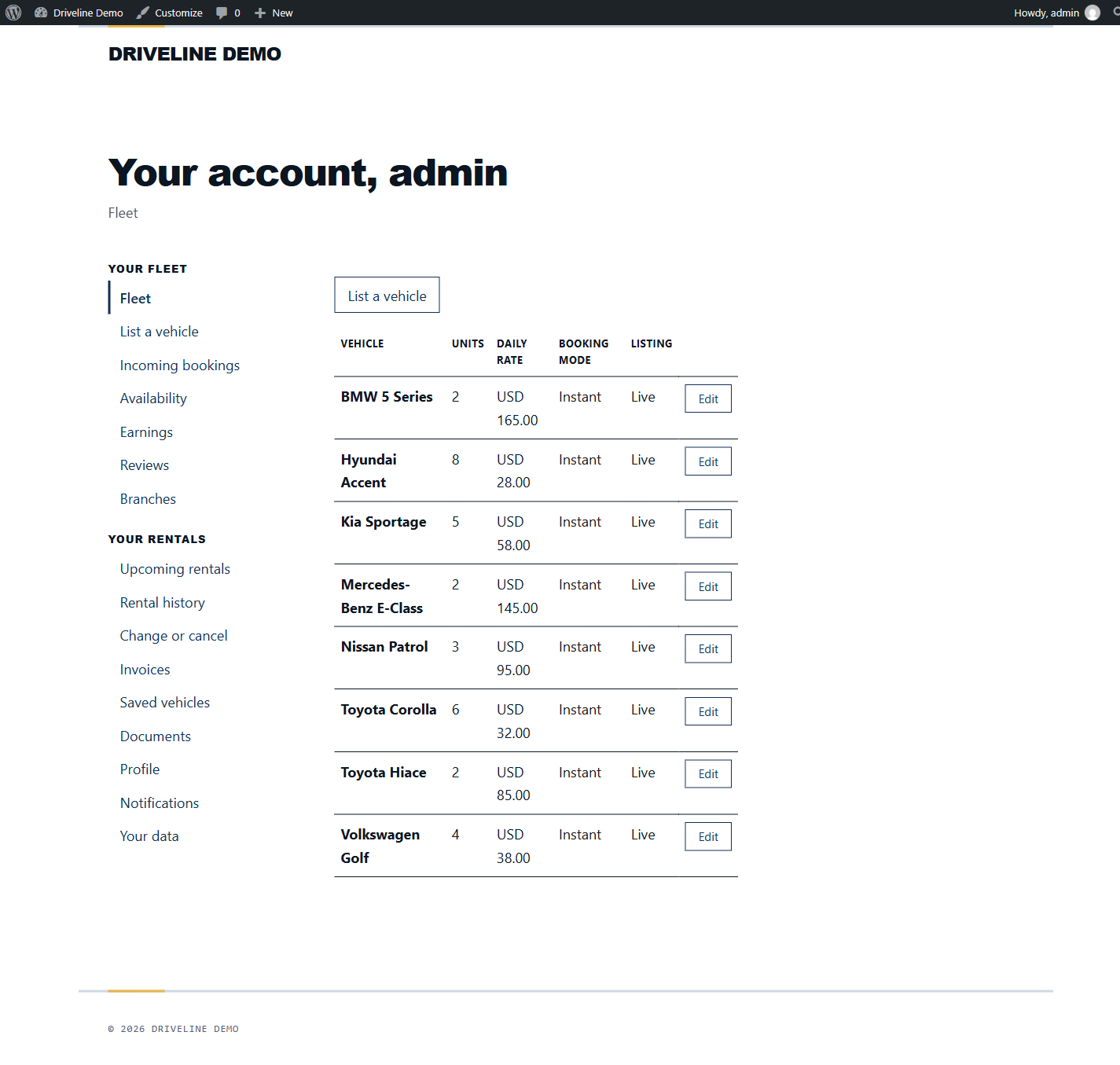
The operator dashboard, with every vehicle, the units behind it, the rate it is priced at and whether it takes an instant booking.
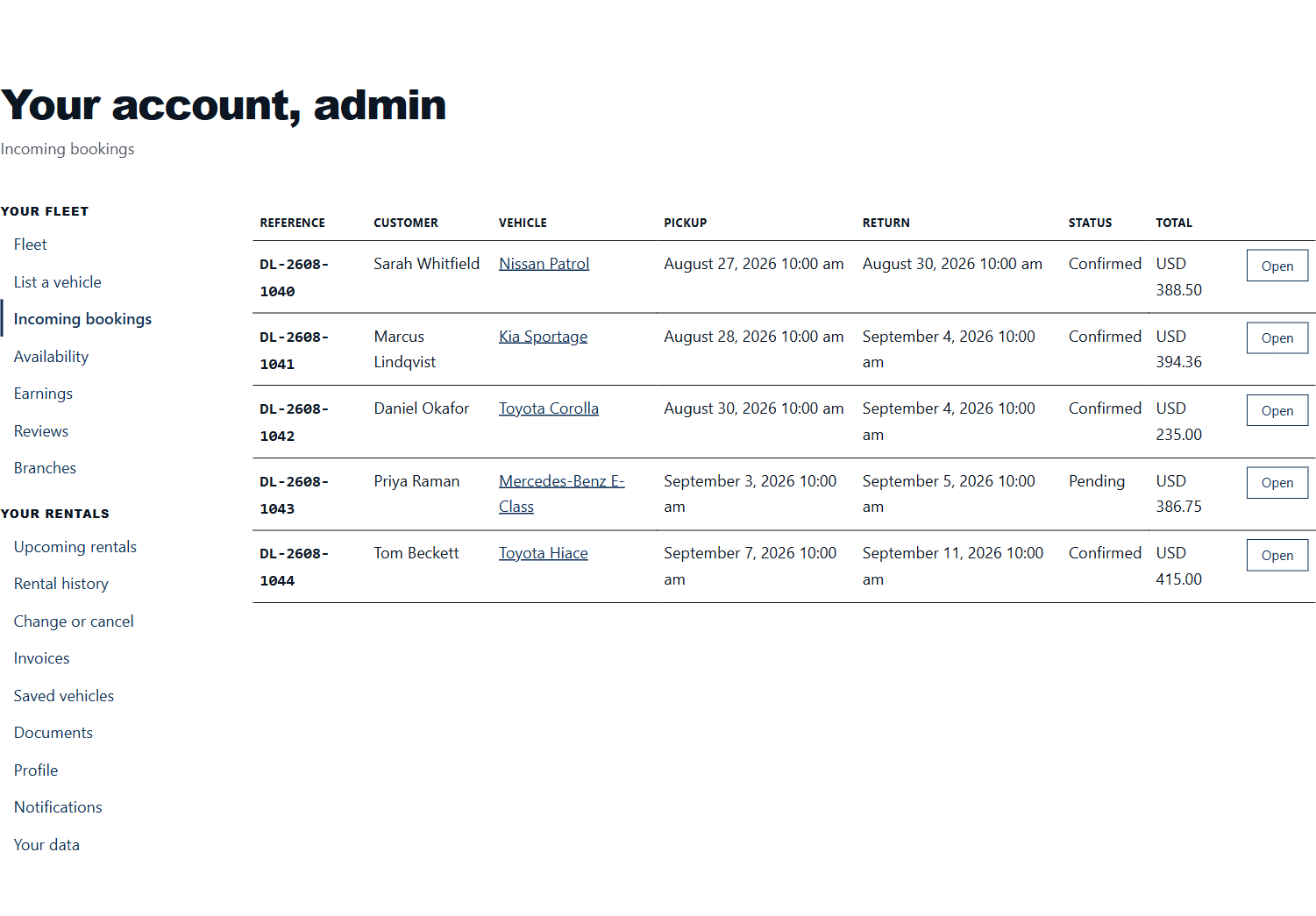
Incoming bookings, each with its reference, the customer, the branches, the dates and the total the pricing rules produced.
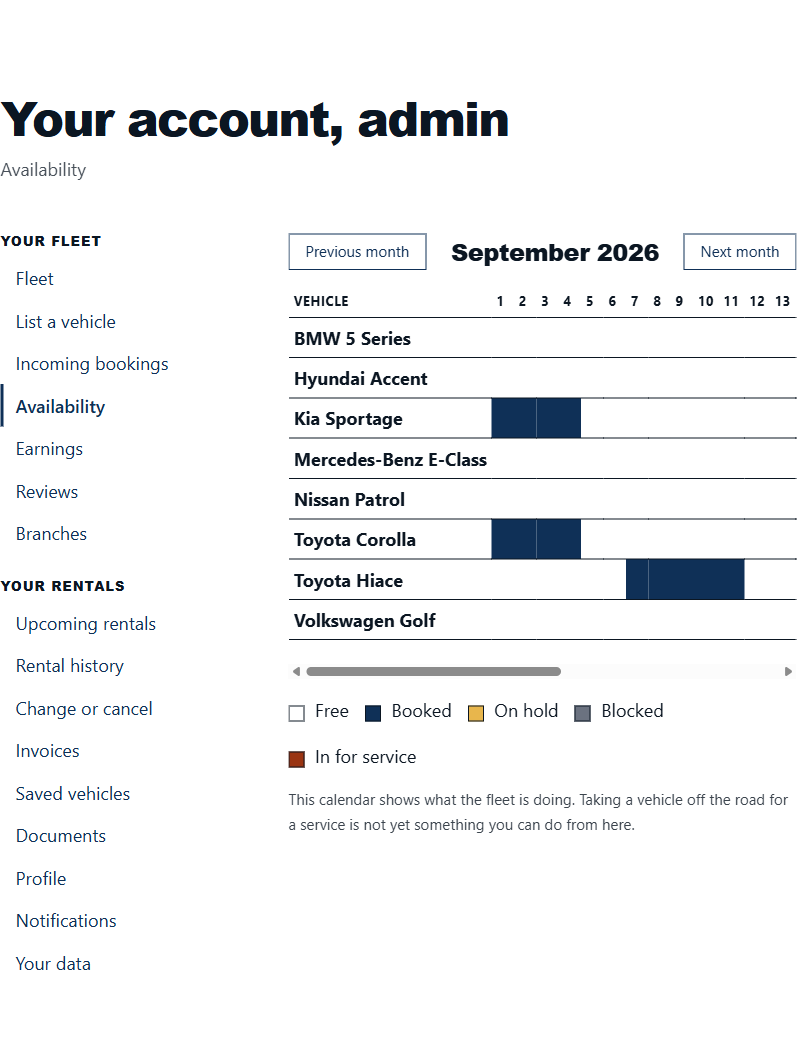
The month calendar, showing at a glance what every vehicle in the fleet is doing.
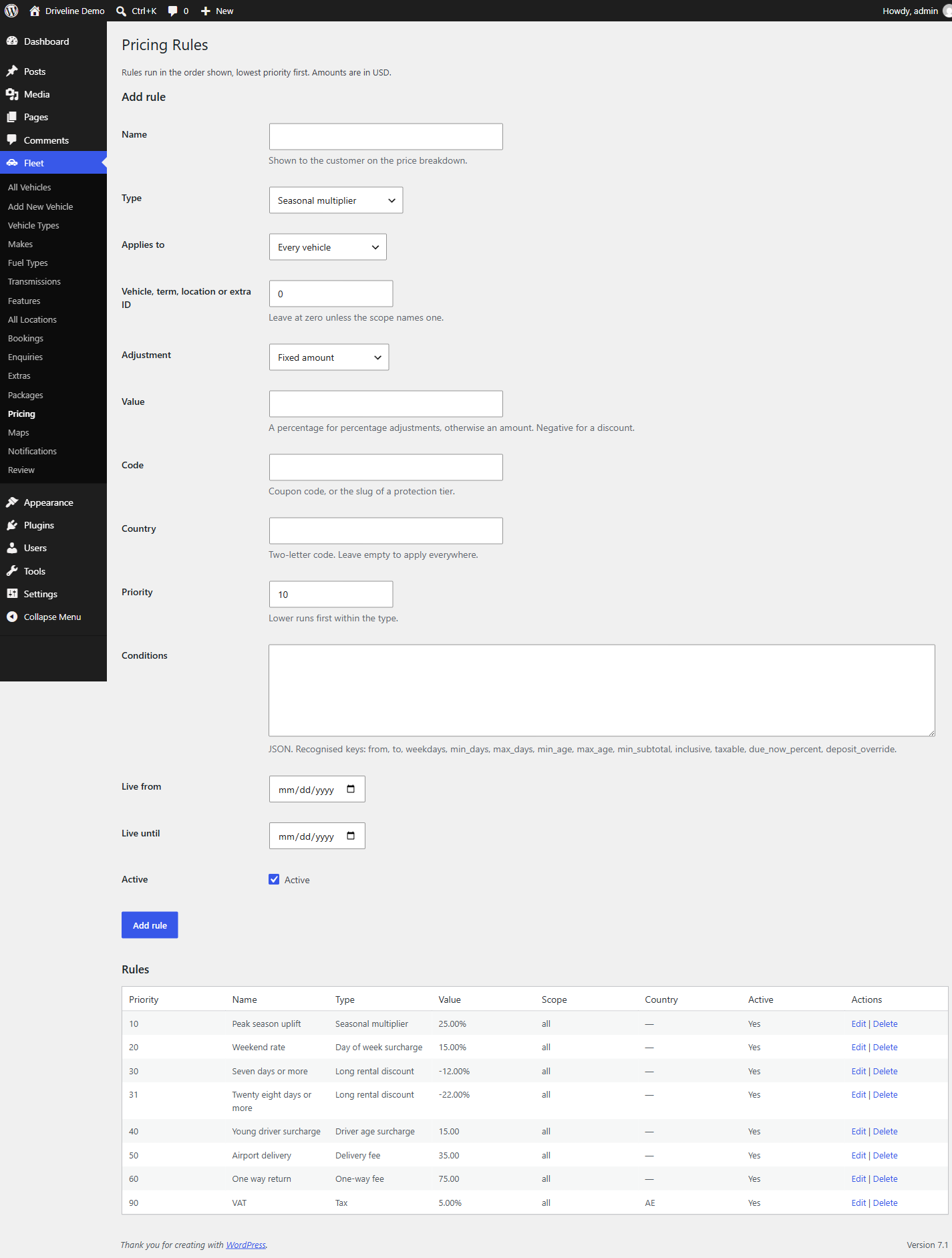
Pricing rules, layered in the order they run: seasons, weekends, long rentals, driver age, delivery, one way returns and tax.
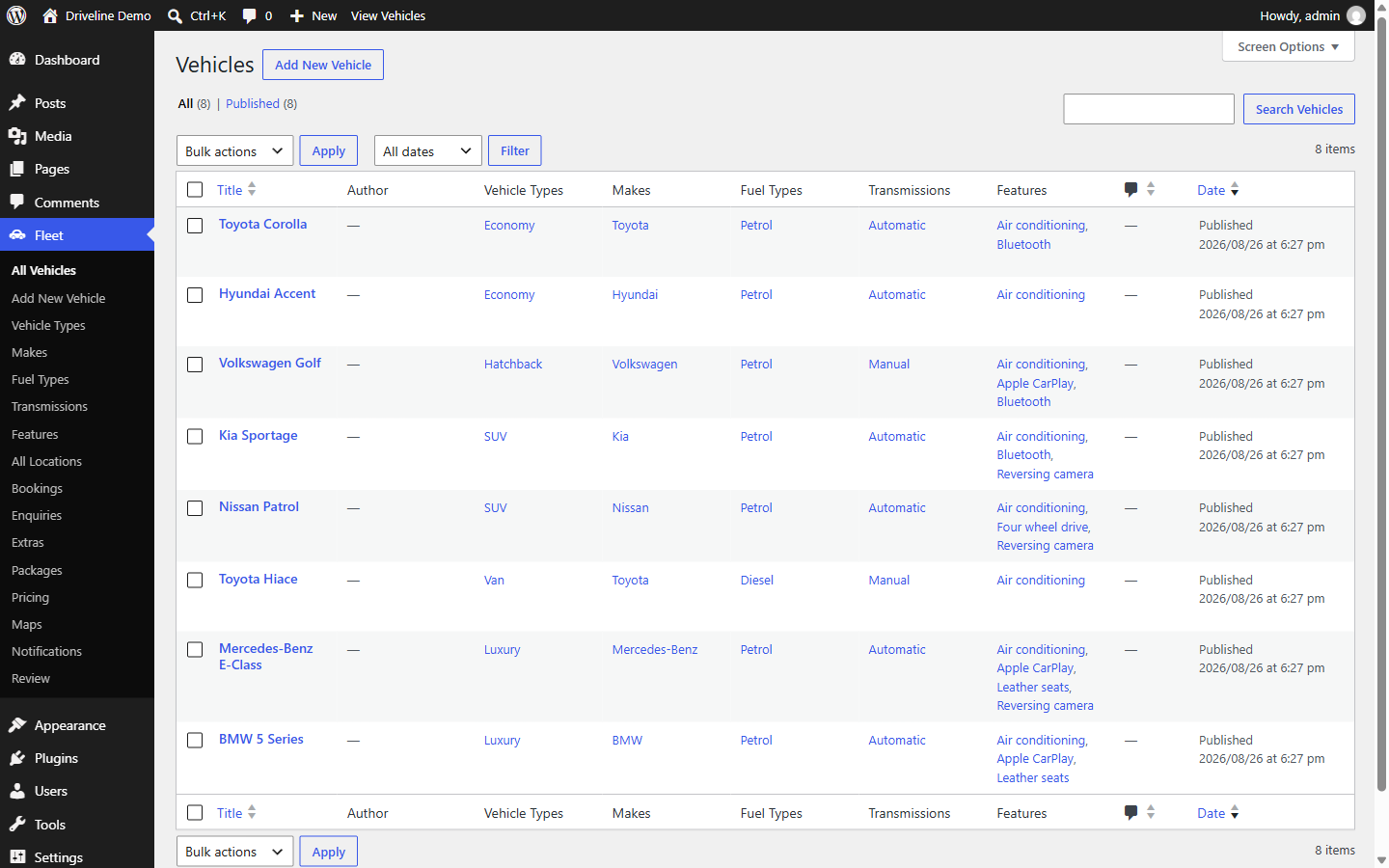
The Fleet menu, with every listing and the make, type, fuel, transmission and features it is filed under.
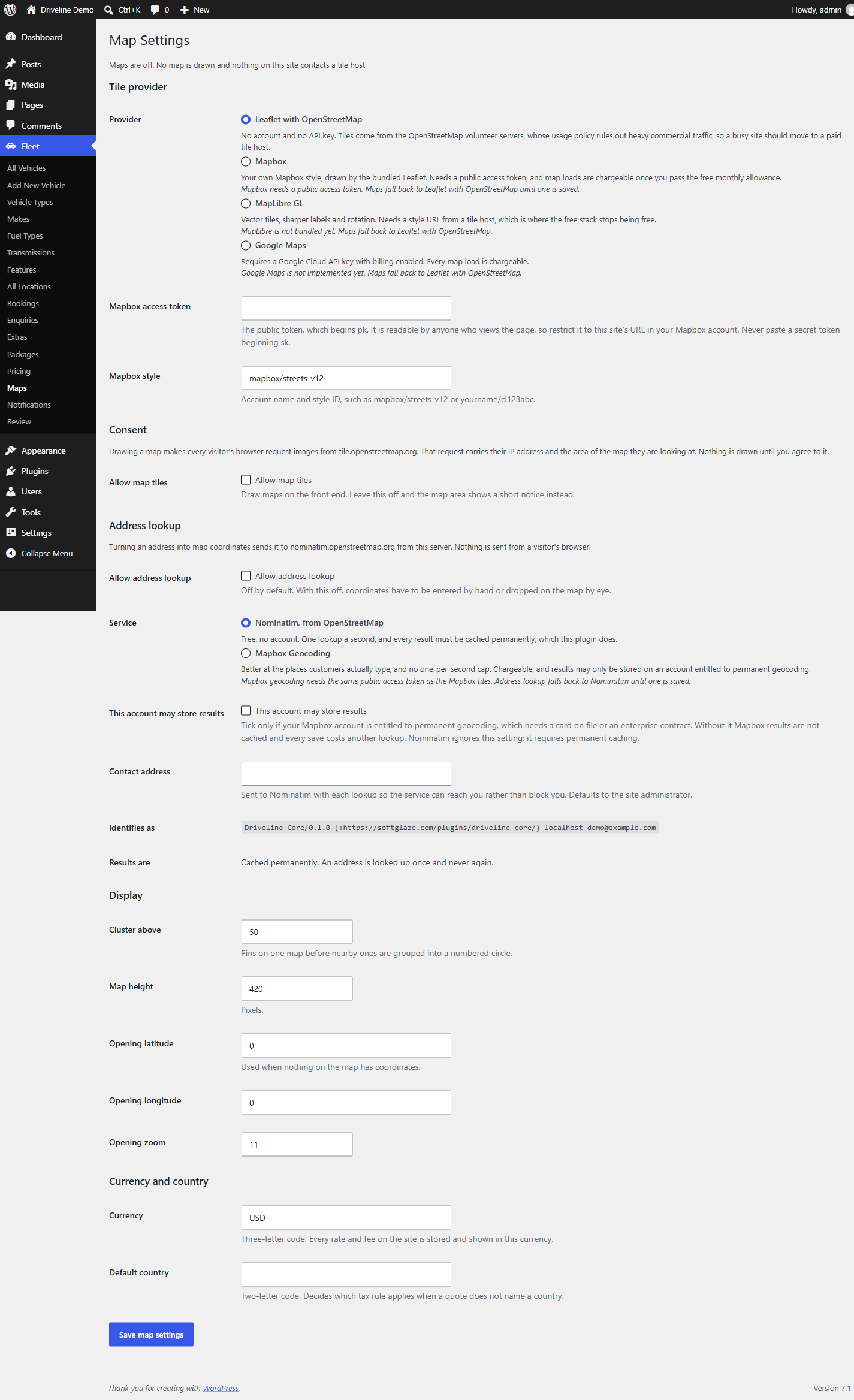
Map settings. Every external service is off until an administrator turns it on, and the screen says what each one sends.